Total Pageviews

Wednesday, 19 November 2014

When It Comes To The Crunch...

Like most enthusiasts I have far too many bikes, and as a result they don't get the regular use that they deserve. One of the consequences of this is a nasty and potentially expensive crunch when trying to engage first gear after anything other than a few days lay up. This occurs on a couple of my bikes even after much kicking and rocking to free the plates.

My first attempt at solving this on the Comet was to spend £450 on a new Conways Honda clutch conversion. This runs in ATF and is set up perfectly. Unfortunately it didn't work.

The second attempt involved a 2p cable tie, and this has proved far more successful. Let me tell you more. I was chatting to an old guy a couple of months ago and he suggested a simple, but quite brilliant method of eliminating this. Just get a cable tie and fasten it loosely around the handlebar grip and when you leave the bike for any length of time, use it to hold the clutch in. Since I've done this with my crunchy Comet, the difference has been remarkable. Not only has the noisy first gear been solved, but the gear change as a whole is vastly improved to the extent that I now realise that I don't need a new gearbox.

Granted, over time it may weaken the clutch springs (we'll have too see), but I'd far rather replace them than start buying new cogs for a Burman gearbox.


Quick Review - Replica Miller Ammeter

A genuine old Miller 2" ammeter in reasonable condition will cost you anywhere up to £150. If it's a 'Lighthouse' you may have to shell out a little more. There are many new replicas listed on eBay, but how good are they?

Well I'm pleased to say that they are not bad at all. I purchased one as a replacement for a cracked and  brittle original and for the very reasonable price of £33 it's a pretty good likeness and looks to be good quality. From more than a couple of feet away you'd struggle to tell the difference, with only very slightly thicker text and a stainless steel bezel marking the 'fake' from the real thing. Make sure that you get the shallow case version, or you may find that your headlight reflector fouls.

OBB seal of approval awarded.

This is the real thing

This is 20% of the price of the real thing


Quick Review - New Doherty Levers


I recently decided to get new clutch and brake levers for my Vincent Comet, as the old ones were not only worn out, but had the wrong fulcrum length. Throwing caution to the wind, I decided to go for British made Dohertys at the whopping price of £60 plus post for the pair.

Sadly, it seems that British craftsmanship ain't what it used to be. Finish on the blades is poor, the chrome plating on the levers is flat and thin. The threads for the mounting clamp are metric, as is the pivot screw, so this means that I can't use the nice stainless BA screws from the old levers. Other than that they do the job, but I'd have been much happier paying half the price for them.

It's sad when a once illustrious name is tagged to sub-standard goods.


So, what is fulcrum length? Many people are unaware that levers were originally specified with different 'pull ratios'. The distance between the centre of the pivot and the centre of the cable nipple was available with 3 different measurements - 7/8", 1" and 1 1/16". The longer the measurement, the more pull and stiffer action, the shorter the measurement, less pull and easier action.

If you have a dragging or stiff clutch, it might be worth checking that the levers are to the correct spec. It's also an effective way of 'tuning' the feel of your front brake. It won't solve other problems, but it may well help.


Sunday, 4 November 2012

The Name's Jones - Casey Jones.

It's hard to believe some of the things that were used by the MOD in the Second World War.

I recently acquired a little steam engine manufactured by Stuart Turner, who are well known for their models, but this one looked a little bit unusual. A bit more substantial, a bit more professional looking and really quite rugged instead of pretty. Turns out that it was originally part of a 'Firefly Generating Unit', which was apparently parachuted behind enemy lines to enable spies to re-charge their radio batteries.

Quite how an Agent could get some coal and water,  fire up a boiler and then operate a steam powered generator whilst remaining under cover is beyond me, but apparently they did.


Standing about 6" high, it's a 2 cylinder engine that produces somewhere around a third of a horsepower. The last pic shows the engine in situ as part of a Firefly Generator. The boiler was additional to this and would be the hardest part to conceal under your coat.


Saturday, 19 May 2012

Warning - this post may contain traces of scooter


I'm very lucky that my girlfriend both humours and tolerates my passion for bikes. She's quite interested in old knackers (hence our lasting relationship), and she even has a wish list of her own 2 wheeled classics. At the very top of that list is the Italjet Veloricifo, a retro styled 50cc twist'n'go that enjoyed celebrity status in the late 1990's. Oasis, Johnathan Ross, Jamie Oliver and other members of the then glitterati gave fleeting patronage to this little scoot, providing it with an image far in excess of the measly 229 that were sold in the UK.


There's no doubting that (if you like scooters) the Velocifero is a very cute little bike. In fact it's probably the best looking rendition of a classic style scooter that has ever been built, certainly more attractive than anything Vespa have ever made. But that's hardly surprising when you consider that the man at the helm of Italjet was no less than Leopoldo Tartarini, the designer that Ducati commissioned to dig them out of a very big Giugiaro shaped hole that was the 860GT. The result of his efforts was the Ducati Darmah, one of my favourite bikes of the 70's.


I've always admired Italjet for the sheer audacity of their bikes. Any small company who can design and successfully market a 80+mph hub centre steering trellis framed scooter gets my vote, and although the Dragster is probably their best remembered bike, in the 60's they dabbled with bigger stuff in the form of Triumph and Velocette engined bikes and it was they who were behind the Clymer Indian Velo which is now so coveted.


The upshot of this story is that I'm now having to make room in my overcrowded garage and time in my overburdened schedule for her soon to be arriving Velocifero. To be honest, i'm quite looking forward to it. The oil in a Norton Commando takes about 10 miles to warm up and our local shops are only a few hundred yards down the road.


Tuesday, 8 May 2012

K&N Commando Filter

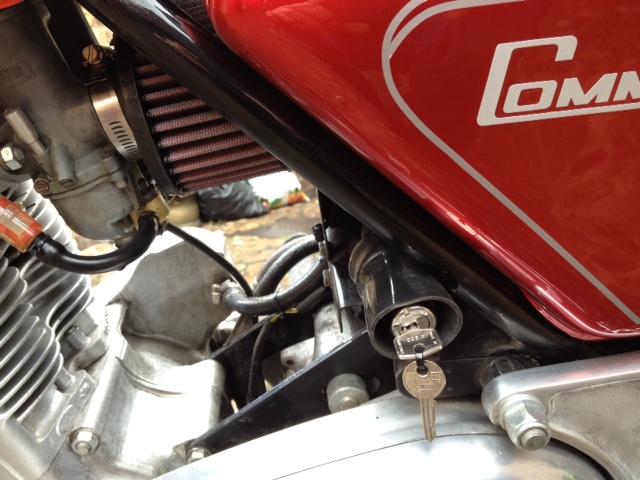
The K&N I fitted to the Commando is in my opinion, a much nicer answer than the complicated and difficult to remove standard filter. 

Some people on the forums seem to have trouble with this conversion, but my bike is all standard but for 270 main jets (260 standard) and I have found the bike runs great with the K&N, no flat spots or hesitation and a good mixture on the plugs as best as I can tell with modern petrol.

The fitment also allowed me to re-position the horrible ignition switch. I did this by cutting off the old bracket from the original bent backplate and sticking it onto the battery carrier with double sided car body tape which is usually used for attaching spoilers and bodykits. I use this stuff a lot, it's very strong and eliminates the need to drill holes. Much better.


Sunday, 6 May 2012

Tri-Spark Ignition - a nice bit of kit


My intention is to use the Commando regularly, so I decided to scrap the rather mangled looking points setup and go with electronic ignition (must be a throwback to the 70's that - we don't say electronic kettle or electronic blanket).

It seems that Boyer or Pazon are the two most popular Commando systems, so true to form, I bought a Tri-Spark. And i'm really glad I did. It's more expensive than the others, but offers a much neater installation due to the fact that the whole thing fits behind the points cover and there is no box to site under the tank. In addition there are no loose wires or visible components as the electronics are encapsulated into a good looking machined alloy housing.

Fitting was a half hour job, and at the same time I replaced both coils to make sure that the whole system was as good as possible. The Tri-Spark has a static timing LED which makes initial setting up really easy, and when checked with a strobe, it was a mere 2 degrees out. A pair of Iridium plugs finished off the job and although the bike ran ok on the points, it now ticks over like a watch and pulls more cleanly from low revs. Best of all, I know it will stay that way.


Tri-Spark Ignitions are made by a company in Australia. See this link for more info:


Bought my Tri-Spark in the UK from LP Williams. Next day delivery.