Total Pageviews

Friday, 27 February 2015

Restore or recommission?


I've only restored one bike in my life. It was a Honda CB92 and it was so nice when it was finished that I couldn't bear to ride it. My OCD went into overdrive and I started to poke bits of dust from its crevices with a cotton bud. It was sold to someone who didn't have my issues and I suspect they gained as much enjoyment from it as I did anxiety attacks.

All of my other bikes have been recommissioned.  Now to some, recommissioning means an oil change and a wipe over with WD40. For me, the object of the exercise is to end up with a bike which looks old but cared for. A bike which starts, stops and rides exactly like it should.

This only works if you choose the right bike in the first place, namely one that is reasonably tidy and complete. Paintwork has to be sound as any repainting spoils the overall patina of the finished bike. As soon as you paint a tank, the original seat cover looks tatty and as soon as you re-cover the seat, the chrome starts to look bad. Before you know it, you're on the road to restoration.

Mechanical issues are not too much of a problem as you can blend the repairs in to the overall look of the bike.

I've been working on a low mileage BSA B50ss which luckily, had no major problems, but still required lots of deep cleaning and a fair bit of money throwing at it. A tin of 20/50 and an oily rag may be cheap, but properly recommissioning a bike is not. Here's a list of the main bits I had to replace in order to get the old girl sorted:

New Amal carb - £130
New oil lines - £20
New Motobatt battery - £70
New kickstart quadrant - £80
NOS chaincase - £150
New chain - £30
All new cables - £90
New petrol taps - £25
Pipe & in-line filters - £12
New handlebars - £35
New grips - £12
NOS air filter £40 (!)
Airbox - £30
Carb to airbox rubber - £12
New tyres - £120 (not fitted yet)
Allen screw set - £20
Gaskets - £15
New oil strainer - £20
Oil - £20

So that's a whopping £931 plus about 40 hours of cleaning, servicing and fettling. Was it worth it? Absolutely. The end result is a cracker of a bike which looks really nice and still retains most of its original finish. It rides like you'd expect with such low mileage and the great thing is, there'll be no problems taking out in the wet or even getting a bit of mud on the tyres.


If you're into BSA unit singles, there's a really good forum at:
www.b50.org


Thursday, 8 January 2015

Aspen - Because they're worth it


I don't know about you, but the thought of crappy petrol and ethanol gives me nightmares over the winter months when my bikes are laid up. I've tried or considered a few options since this became a problem.

Drain the tanks? Then you have a bare metal tank which to me isn't that good an idea. Also not kind on cork washers in fuel taps as I found out to my cost when they shrunk beyond repair and needed replacement.

Stabiliser? I find it hard to believe that a 1-2% mix of anything will fix all of the ills of modern fuel and prevent corrosion due to water content.

Fill the tank to the top? Hmmm. Even more fuel and more water hygroscopically absorbed by the ethanol.

Luckily I have discovered a better answer. Aspen is a pure petrol sold in 5 litre containers designed primarily for use in garden machinery. Putting aside the fact that it is way more environmentally friendly, it has NO ethanol and is so pure and stable that it lasts for five years before loosing any potency. The downside is cost, but at around £18 for a once yearly five litre slosh, its a damn sight cheaper than a new tank or an ultrasonic carb clean. Aspen is available in straight petrol or 50:1 premix. Get the blue can and if you need to put 2 stroke in it, you can mix your own ratio.

I've just drained all the rubbish out of my tanks and installed a can of Aspen in each bike and flushed it through to the carbs. No more sleepless nights, and as a bonus, you end up with a very nice re-useable container to store pump petrol for the car or mower.


Here is a link to the Aspen website:
http://www.aspenfuel.co.uk


Wednesday, 7 January 2015

B50SS - The Bike That Dare Not Speak Its Name


When I was 14, I had a poster on my bedroom wall which featured an OIF BSA A65 Lightning and a B50SS. I've never really paid much attention or registered any emotion for these bikes since then, but these things must have a profound psychological impact because when I stumbled across this bike for sale in December I just had to get my hands on it.

Unbelievably skinny and very light at 140kg, the B50 was the very last in the line of British 500 singles, and as such deserves a place in motorcycling history. With a punchy 34bhp engine and 'trail' styling, its looks were somewhat ahead of its time.

Controversially, BSA decided to add the 'Gold Star' name to the SS, which deeply offended DBD owners. To be fair, as well as setting a TT lap record and winning its class in both the Thruxton 500 and the Barcelona 24 hours, the B50 (with assistance from CCM) went on to have an illustrious off road competition career so maybe in hindsight it has earned the right to use that sacred title.

I think I'll to refer to it as a 'Goldie' just to annoy people.

My example is an American import (as most are), with only 11,000 miles on the clock and is in very original condition. I'm not going to restore it, I think that would be a shame. Just a thorough re-commission and a good clean and polish should result in a nice, useable bike with some patina.


Tuesday, 6 January 2015

Amal Carbs - The Proper Way To Restore A Distorted Flange

I'm in the process of bringing another bike back to life, and as usual the Amal Concentric carb has been over tightened. As a consequence, the flange is warped. It's a low mileage bike and the carb is surprisingly good, so it's worth fixing.

Now the obvious thing to do would be to get a sheet of glass, some 400 grade wet and dry, and rub away to flatten the flange. Obvious, but not really the best way. A more effective solution is to use an accurately made tool to apply the opposite pressure to push it back into shape. Not only will this bring the flange back to true, it will restore the shape of the rest of the body which has been distorted.

I made the tool a few years ago and it has rescued quite a few carbs from the scrap bin. The base is a flat alloy block with a threaded rod fastened securely into the centre. The 'slide' is turned from solid alloy and is machined to fit the carb bore accurately.

You simply pop the 'slide' into the carb, feed the threaded bar through a hole which is drilled to be central to the inlet and then as you tighten the nut, it pushes the whole thing back into shape. A pair of of 5 or 10 thou feeler gauges (one placed below the mounting hole on each side), allow you to bend the flange past straight so that when the nut is loosened the natural spring in the metal will leave the joining surface and the body absolutely true.

With the aid of this simple device, it takes about two or three minutes to fix a carb properly. If you work on old bikes regularly, it's well worth knocking one up.


See this link for information on how to install an Amal carb:

Wednesday, 19 November 2014

When It Comes To The Crunch...

Like most enthusiasts I have far too many bikes, and as a result they don't get the regular use that they deserve. One of the consequences of this is a nasty and potentially expensive crunch when trying to engage first gear after anything other than a few days lay up. This occurs on a couple of my bikes even after much kicking and rocking to free the plates.

My first attempt at solving this on the Comet was to spend £450 on a new Conways Honda clutch conversion. This runs in ATF and is set up perfectly. Unfortunately it didn't work.

The second attempt involved a 2p cable tie, and this has proved far more successful. Let me tell you more. I was chatting to an old guy a couple of months ago and he suggested a simple, but quite brilliant method of eliminating this. Just get a cable tie and fasten it loosely around the handlebar grip and when you leave the bike for any length of time, use it to hold the clutch in. Since I've done this with my crunchy Comet, the difference has been remarkable. Not only has the noisy first gear been solved, but the gear change as a whole is vastly improved to the extent that I now realise that I don't need a new gearbox.

Granted, over time it may weaken the clutch springs (we'll have too see), but I'd far rather replace them than start buying new cogs for a Burman gearbox.


Quick Review - Replica Miller Ammeter

A genuine old Miller 2" ammeter in reasonable condition will cost you anywhere up to £150. If it's a 'Lighthouse' you may have to shell out a little more. There are many new replicas listed on eBay, but how good are they?

Well I'm pleased to say that they are not bad at all. I purchased one as a replacement for a cracked and  brittle original and for the very reasonable price of £33 it's a pretty good likeness and looks to be good quality. From more than a couple of feet away you'd struggle to tell the difference, with only very slightly thicker text and a stainless steel bezel marking the 'fake' from the real thing. Make sure that you get the shallow case version, or you may find that your headlight reflector fouls.

OBB seal of approval awarded.

This is the real thing

This is 20% of the price of the real thing


Quick Review - New Doherty Levers


I recently decided to get new clutch and brake levers for my Vincent Comet, as the old ones were not only worn out, but had the wrong fulcrum length. Throwing caution to the wind, I decided to go for British made Dohertys at the whopping price of £60 plus post for the pair.

Sadly, it seems that British craftsmanship ain't what it used to be. Finish on the blades is poor, the chrome plating on the levers is flat and thin. The threads for the mounting clamp are metric, as is the pivot screw, so this means that I can't use the nice stainless BA screws from the old levers. Other than that they do the job, but I'd have been much happier paying half the price for them.

It's sad when a once illustrious name is tagged to sub-standard goods.


So, what is fulcrum length? Many people are unaware that levers were originally specified with different 'pull ratios'. The distance between the centre of the pivot and the centre of the cable nipple was available with 3 different measurements - 7/8", 1" and 1 1/16". The longer the measurement, the more pull and stiffer action, the shorter the measurement, less pull and easier action.

If you have a dragging or stiff clutch, it might be worth checking that the levers are to the correct spec. It's also an effective way of 'tuning' the feel of your front brake. It won't solve other problems, but it may well help.


Sunday, 4 November 2012

The Name's Jones - Casey Jones.

It's hard to believe some of the things that were used by the MOD in the Second World War.

I recently acquired a little steam engine manufactured by Stuart Turner, who are well known for their models, but this one looked a little bit unusual. A bit more substantial, a bit more professional looking and really quite rugged instead of pretty. Turns out that it was originally part of a 'Firefly Generating Unit', which was apparently parachuted behind enemy lines to enable spies to re-charge their radio batteries.

Quite how an Agent could get some coal and water,  fire up a boiler and then operate a steam powered generator whilst remaining under cover is beyond me, but apparently they did.


Standing about 6" high, it's a 2 cylinder engine that produces somewhere around a third of a horsepower. The last pic shows the engine in situ as part of a Firefly Generator. The boiler was additional to this and would be the hardest part to conceal under your coat.


Saturday, 19 May 2012

Warning - this post may contain traces of scooter


I'm very lucky that my girlfriend both humours and tolerates my passion for bikes. She's quite interested in old knackers (hence our lasting relationship), and she even has a wish list of her own 2 wheeled classics. At the very top of that list is the Italjet Veloricifo, a retro styled 50cc twist'n'go that enjoyed celebrity status in the late 1990's. Oasis, Johnathan Ross, Jamie Oliver and other members of the then glitterati gave fleeting patronage to this little scoot, providing it with an image far in excess of the measly 229 that were sold in the UK.


There's no doubting that (if you like scooters) the Velocifero is a very cute little bike. In fact it's probably the best looking rendition of a classic style scooter that has ever been built, certainly more attractive than anything Vespa have ever made. But that's hardly surprising when you consider that the man at the helm of Italjet was no less than Leopoldo Tartarini, the designer that Ducati commissioned to dig them out of a very big Giugiaro shaped hole that was the 860GT. The result of his efforts was the Ducati Darmah, one of my favourite bikes of the 70's.


I've always admired Italjet for the sheer audacity of their bikes. Any small company who can design and successfully market a 80+mph hub centre steering trellis framed scooter gets my vote, and although the Dragster is probably their best remembered bike, in the 60's they dabbled with bigger stuff in the form of Triumph and Velocette engined bikes and it was they who were behind the Clymer Indian Velo which is now so coveted.


The upshot of this story is that I'm now having to make room in my overcrowded garage and time in my overburdened schedule for her soon to be arriving Velocifero. To be honest, i'm quite looking forward to it. The oil in a Norton Commando takes about 10 miles to warm up and our local shops are only a few hundred yards down the road.


Tuesday, 8 May 2012

K&N Commando Filter

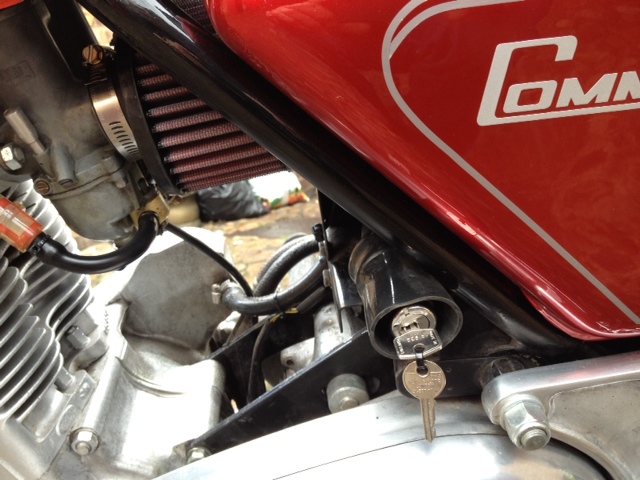
The K&N I fitted to the Commando is in my opinion, a much nicer answer than the complicated and difficult to remove standard filter. 

Some people on the forums seem to have trouble with this conversion, but my bike is all standard but for 270 main jets (260 standard) and I have found the bike runs great with the K&N, no flat spots or hesitation and a good mixture on the plugs as best as I can tell with modern petrol.

The fitment also allowed me to re-position the horrible ignition switch. I did this by cutting off the old bracket from the original bent backplate and sticking it onto the battery carrier with double sided car body tape which is usually used for attaching spoilers and bodykits. I use this stuff a lot, it's very strong and eliminates the need to drill holes. Much better.


Sunday, 6 May 2012

Tri-Spark Ignition - a nice bit of kit


My intention is to use the Commando regularly, so I decided to scrap the rather mangled looking points setup and go with electronic ignition (must be a throwback to the 70's that - we don't say electronic kettle or electronic blanket).

It seems that Boyer or Pazon are the two most popular Commando systems, so true to form, I bought a Tri-Spark. And i'm really glad I did. It's more expensive than the others, but offers a much neater installation due to the fact that the whole thing fits behind the points cover and there is no box to site under the tank. In addition there are no loose wires or visible components as the electronics are encapsulated into a good looking machined alloy housing.

Fitting was a half hour job, and at the same time I replaced both coils to make sure that the whole system was as good as possible. The Tri-Spark has a static timing LED which makes initial setting up really easy, and when checked with a strobe, it was a mere 2 degrees out. A pair of Iridium plugs finished off the job and although the bike ran ok on the points, it now ticks over like a watch and pulls more cleanly from low revs. Best of all, I know it will stay that way.


Tri-Spark Ignitions are made by a company in Australia. See this link for more info:


Bought my Tri-Spark in the UK from LP Williams. Next day delivery.

Wednesday, 25 April 2012

The washer's broke, so I've gone Commando


I've got a confession to make. I've never really had what you might call a 'normal' vertical twin classic bike. In various acts of masochism and self harm, I always seem to be slightly drawn to the left field, and a succession of bikes from the smaller (usually idiosyncratic) manufacturers, punctuated by a few of the bigger branded single cylinder bikes have graced my garage and emptied my wallet.

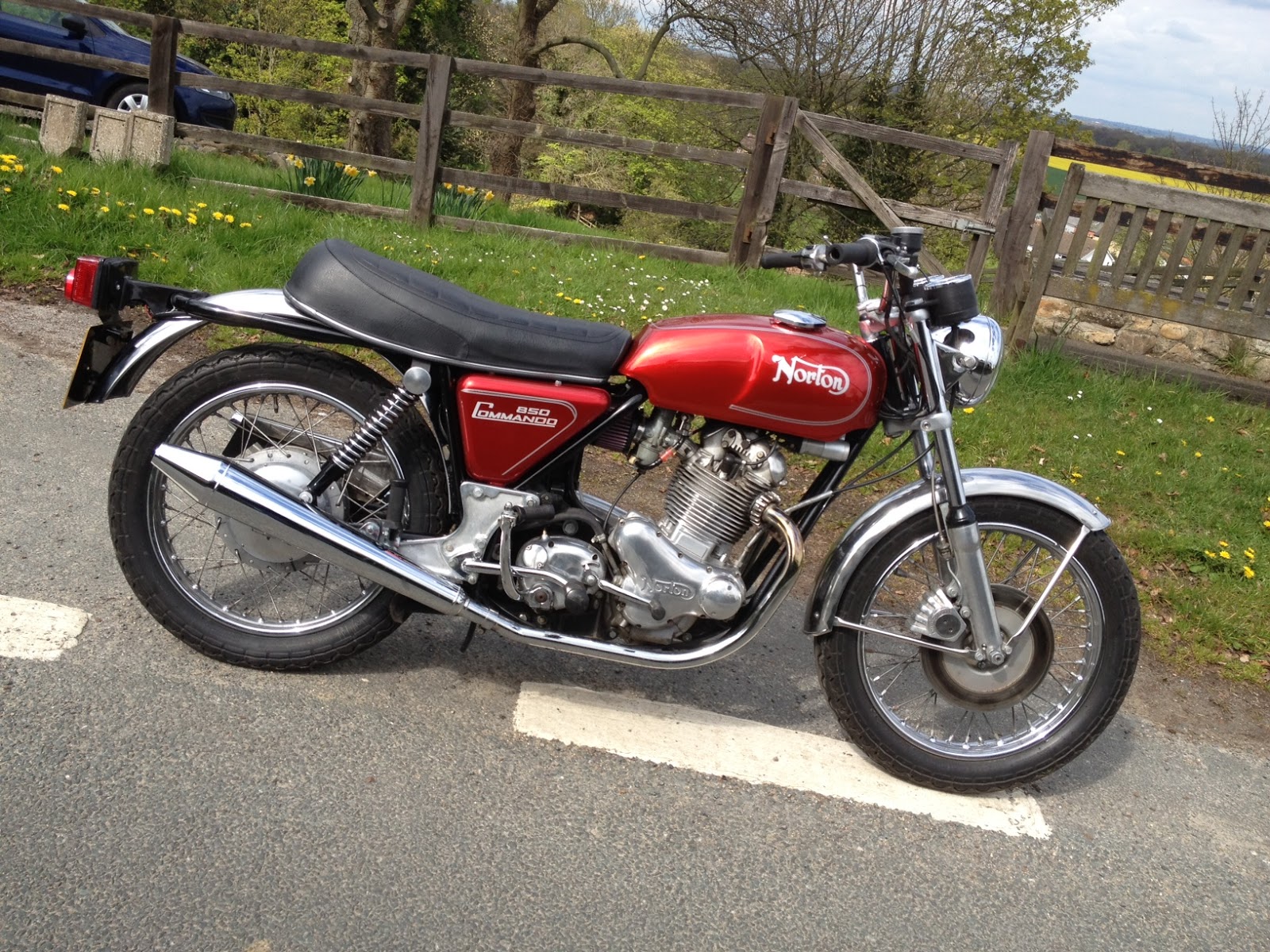
Up to now the charms of Bonnies, A10's, Dominators etc., have largely passed me by but I have to admit to always liking the look of Commando Roadsters. Well, that itch has been scratched thanks to the proceeds of a bike sale coinciding with a late night ebay session (originally intended to find a new washing machine), and I am now the proud owner of a '74 Mk2 850. I fell in love with it instantly and thanks to J&M Couriers it was sat in my yard a couple of days after pressing the 'buy it now' button.

The bike is an American import and has only covered 9500 miles from new. Someone has very kindly painted the tank and panels rather nicely and in general terms it is very original, clean and straight looking. The Mk2 850 is regarded to be amongst the best versions of the Commando, combining the 750's light weight and lack of any emissions stuff with the punchy 850 engine. I spent the first hour of ownership looking at it from many different angles.

Oil and filter were changed, the too tight primary chain adjusted and the carbs were balanced. Ignition timing, (which is still on points) was set and then checked with a strobe. Due to badly distorted end plates, the standard air filter was very much more air than filter so I replaced it with a neat dual K&N which also looks a lot cleaner and gives a bit of 'gap' in the frame.

With this done, I turned my attention to the cosmetics and detail, and ordered a new set of bars, front and rear guards and a few other bits and bobs from RGM in Cumbria. The end result is what you see above.

Riding impressions so far have been a bit of a revelation. The Commando is probably the best classic bike (to ride) that I have owned. You may think this is a bit of a sweeping statement, but in real terms it does so much so well. The engine is lovely, with fabulous mid range punch and performance is well up to modern traffic. Handles great, brakes are better than expected, and the vibes disappear after 3000rpm. Distances are dispatched quickly and comfortably, scratching is undertaken with aplomb and killer looks place it near the top of the 'kerb appeal' stakes. And to think I owe it all to Indesit.

I think it's safe to say that in classic bike terms, a Commando will probably do everything you ever need - or want it to. Is that enough? Only time will tell...


J&M Couriers give a top class service, I've used them for many years.
See their website here:
http://www.collectmybike.co.uk/

RGM Motors in Cumbria have had all of the bits in stock and sent them next day - excellent
http://rgmmotors.co.uk/

Friday, 30 December 2011

Coming soon - Ducati 750GT

I've recently managed to get my hands on a 1974 Ducati 750GT for a while and I'll soon be posting a few articles on fettling and riding this magnificent machine. This is the Daddy of all Ducati 'V' twins and as such, represents a very significant moment in motorcycling history. You may notice that I don't buy into the whole 'L' twin idea - if a Moto Guzzi 90 degree engine is a 'V', then so is the Ducati.

First impressions are very good. What a cracker of an engine, in a chassis that works really well for the period. I'm rather smitten by it right now, and would have one in a heartbeat if funds allowed. I should have bought one a few years ago before the prices of bevel twins started to hit the classic bike premier league. Bugger...


Engine looks as good as it goes.

Wednesday, 28 December 2011

KD Benches. Made in Scotland - from wee girders!

As well as Iron Bru, haggis and very good malt whisky, Scotland has another lesser known (but equally fine) export in the form of KD Benches.

I've been looking for a bike lift for a while, and despite some very good personal recommendations of other makes, I finally decided to go with KD. A few days before Christmas, I ordered a standard size bench with a front wheel clamp at a cost of £440 delivered, and astonishingly it arrived only 2 days later on the 23rd. Assembled and well packed, the driver and I struggled with the 80 odd kilo package (I'm not getting any younger), and it was breathlessly deposited in my yard.

It was then that I remembered the time we had a one ton safe delivered to our office. The delivery men simply used a few alloy bars as rollers and it glided into place, so a couple of cut down brooms later, the bench was in position and ready to go. Egyptian technology wins the day.

I'm delighted with my purchase.  Very nicely made, it locks positively in 3 height positions and the whole design works really well. But for me, the killer feature is the wooden top. Not only does it look nice, but the surface is kind to your dismantled covers and parts, and it becomes a convenient work bench to lay out assemblies, components, tools etc.

A top class piece of kit, and best of all it's made in Britain.

See this link for more details:
http://www.kdbenches.co.uk/


Friday, 23 December 2011

5 things that the OBB workshop couldn't live without

1. Facom 1/4 drive socket set
I've had this socket set for about 10 years, and it really does prove that quality tools are worth spending money on. Superbly made, a joy to use and will outlive me.


2. Aldi ultrasonic cleaner
I bought this about 2 years ago for the princely sum of £11.99, and it has been so useful that I can't imagine what it would be like not to have one. A bit on the small side, but with a little ingenuity and juggling you can clean carbs, switches, wiring and even your partners jewellery.


3. Facom stubby 3/8 ratchet
I do like Facom tools. This is a short ratchet and practically guarantees that you will never strip a thread again. Take them off with a long one, put them back on with this.


4. Lock wire
I got this roll of wire in a box of Bantam bits from a chap who worked in the aerospace industry (obviously appreciated fine engineering).

Not only is it great for the obvious, it's pressed into service for hanging up items to paint, poking things clear, temporary hose clips, lashing stuff together and a million other uses.


5. Dremel Stylus
A mini rechargeable Dremel that's always on hand to grind, cut, drill and sand. Another 'couldn't do without' item.


OBB seal of approval - Venture Classics

It gives me great pleasure to recommend top notch businesses on this blog, and Chris Spaett of Venture Classics is right up there with the best. I know a few people who have bought from him (including me), and the feedback about the quality of his bikes and service is universally excellent.

He stocks some very nice stuff, so if you are in the market for a quality addition to your stable, take a look at his website on http://www.ventureclassics.com and buy with confidence. 

There's a few samples of his current stock below. I'd pick the Norvelo myself. And if you're into naming your bikes, you could always call it Ivor...


Thursday, 22 December 2011

Phew! (Vincent winter fettle part 1)

I had some time on my hands today, so decided to get cracking on the pension fund (Rapide). I've had the bike for about a year and when I bought it I decided to enjoy riding it rather than rush to take it to bits, so this is all uncharted territory.

I must have been feeling very brave, because I decided to tackle the most scary job first - a look inside the timing chest. Why scary I hear you all ask? I'll tell you then. It's scary because you can easily spend over £1500 in parts alone to refurbish the potential wear and damage you may find on examination. But it turns out lady luck was on my side today. As I nervously eased the timing cover off, I was greeted by the sight of a lovely lightened steel large idler gear and shaft assembly and the general appearance of a nicely put together engine in good order.


The large idler gear is a bit of an achilles heel with Vincents, because originally the factory fitted them made from alloy. A clever idea, it was intended to expand at the same rate as the cases, keeping things quiet and in a constant state of mesh. Unfortunately after 25+ years, alloy gears are known to shed teeth and distribute the bits throughout the engine, so it's advisable to replace them with steel. This involves stripping the whole timing side down and then re-adjusting mesh (including the selection of the correct sized small gear on the end of the crank from about 20 different sizes. Quite a big job, and since the engine has been running so nicely, I'm loathe to disturb it too much.

So it's just a clean up, new gasket and seals and on to the next job. Watch this space for the next episode, as I get to the bottom of the mystery of the (gradually) vanishing clutch pushrod.

Wednesday, 21 December 2011

It's turning into Vincent week at OBB....

Take a look at this wonderful promotional film by Avon Tyres, which shows a Vincent being ridden in exactly the way that the makers intended. It's fascinating to see the bike in context, and it gives a real sense of just how quick a Rapide could be on the roads that were around at the time.

It also set me thinking that standards in riding attire have clearly been slipping. So all you motorcyclists who've given up wearing a tie when you ride out on your GSXR think on... you're letting the side down.


Monday, 19 December 2011

When the government encouraged motorcycling (by accident of course)


There's an awful lot of people out there who owe a great debt of gratitude to a chap called John Peyton. He was the Transport Minister who, in 1971 introduced the law which restricted 16 year olds to ride mopeds. Hilariously, it had exactly the opposite effect than the one he was hoping for.

Whilst government ministers quaffed their brandies and imagined a few die-hard spotty kids persevering with Raleigh Runabouts, manufacturers both small and large drove a steamroller through the regulations and designed the flashiest, fastest, coolest mopeds imaginable. The 'sixteener special' was born.

By 1974, the big players were Yamaha's FS1-E and the Honda SS50 (AP50's came later). Then there were oddball European makes like Casal, Batavus and KTM(!). Even Mobylette got in on the act. But the real glam, the bikes that were discussed in hushed tones, and the ones that were rumoured to hit 60+ were the Italians. The Fantic TI, Malaguti Olympique and Garelli Tiger Cross had ultimate street credibility, that is of course when they were actually working.

Presumably rattled by this blatant disregard at their attempts to spoil everyone's fun, the government eventually amended the law to limit mopeds to a top speed of 30mph. Amazingly, it took them 6 years, but when they did, the bubble burst almost overnight and the craze was over. Mopeds went back to the uncool wall, and soon kids copped out and were buying cars that previously their Mums wouldn't have been seen dead in. Big exhausts and anodised wheel nuts were still years away, but the trend had shifted.

So, it gives me great pleasure and genuine pride (in this context) to admit that I am 53, and that my motorcycling career began on a full fat, no holds barred sports 'ped.

My first road bike was a Puch VS50, yellow and chrome, with 3 speed hand change. This was soon realised to be a mistake and was quickly chopped in for a Fizzy (it's funny, I don't actually remember anyone calling them Fizzy then).

Yes, CUP 28L was my dream come true. It really was a lovely little bike. Candy gold, with optional indicators, it was one of the very early FS1-E's which had SS50 on the side panels. I think that this badging was quite short lived as presumably, Honda took offence. Anyway, as I was saying, what a lovely bike. It took me everywhere, it made me some lifelong friends, it impressed the right girls, it made me feel part of something, and most of all, it made me fall in love with motorcycles.

So - if you've ever wondered why a very large proportion of bikers are now around 50-55 years old, it's because literally hundreds of thousands of kids like me rode mopeds between 1972-1977. If you are also a member of that short lived unofficial club, then I suggest that you buy this absolutely brilliant book.


144 pages of technicolour 1970's memories can be yours for only a tenner. I bought a copy and I love it. Do yourself a favour and click on the link below.

Now all I need is about four grand plus for an original mint early Fizzy. It's genuinely tempting.

http://www.whsmith.co.uk/CatalogAndSearch/ProductDetails-Funky+Mopeds+-9781845840785.html

Friday, 16 December 2011

Sign of the times?

Can somebody please tell me why there isn't a proper blue plaque at the site of the old Vincent factory in Stevenage? There is, in fact a valiant 'home made' effort, but unfortunately it just doesn't have the same gravitas as the real thing. I understand that the English Heritage scheme only operates in London, but surely Stevenage Council could scrape together a few quid to have a proper 'cast' plaque produced.

At a time when everyone and his dog are banging on about the importance of manufacturing, it's a shame that we can't officially recognise one of the finest and most innovative engineering companies of an industry that was once such a major part of our economy.


Philip Vincent has this...

Whilst Edward Turner has this. Looks like Edward Turner
got a plaque made by Vincent and Philip Vincent got a plaque 
made by Triumph... 

(just a joke all you Triumph fans, 
I'd very much like to own an early 50's T100)